
Best overall: a private company (Pty Ltd) for founders building a business with separate legal identity; best for solo trading with limited administration: a sole proprietorship; best for shared ownership without incorporating: a partnership; best for a non-profit purpose: a non-profit company (NPC). This 2026 guide compares liability, ownership, tax administration and ongoing compliance so you can choose a structure that fits your plans.
- For the best business structure for a startup South Africa decision, choose a Pty Ltd for separate legal identity.
- A sole proprietorship suits solo trading, but the owner carries personal liability for business debts.
- A partnership needs a written agreement covering contributions, decisions, profit sharing and exits.
- An NPC suits a non-profit purpose, not founders seeking shareholder distributions.
Why your business structure matters
Your structure determines who owns the business, who carries its debts and which records you must maintain. A trading name alone does not create a separate legal entity.
Express Reg is best suited to founders seeking company registration and ongoing compliance support. You can review Express Reg for company registration and compliance services. The consultancy is a private business and has no government affiliation.
For a South African startup in 2026, separate the structure decision from the registration task. Decide how ownership and risk should work before submitting an application or buying a pre-registered company.
Criteria for choosing a startup structure
Use these criteria before comparing the options:
- Personal liability: Identify whether creditors can pursue you for business obligations. Personal guarantees can expose you even through a company.
- Ownership: Decide whether you will trade alone, share ownership or invite shareholders later.
- Purpose: Establish whether the business exists to generate distributable profits or pursue a non-profit objective.
- Administration: Assess your capacity to maintain accounting records, submit returns and keep ownership information current.
- Tax treatment: Compare obligations at both business and owner level. A company does not guarantee a lower overall tax burden.
- Continuity: Consider how the business will continue after an owner leaves, dies or sells an interest.
Give liability and ownership priority. An easy registration process cannot repair a structure that conflicts with your agreement between founders.
South African business structures at a glance
| Rank and structure | Best for | Standout feature | Key limitation |
|---|---|---|---|
| 1. Private company (Pty Ltd) | Founders building a separately owned business | Separate legal personality and ownership through shares | Continuing company compliance and administration |
| 2. Sole proprietorship | One owner starting a straightforward trading activity | Owner and business operate without a separate incorporated entity | Personal exposure to business debts |
| 3. Partnership | Co-owners who choose an unincorporated arrangement | Partners agree contributions and profit sharing | Partners face personal liability and must manage shared authority |
| 4. Non-profit company (NPC) | Founders pursuing a qualifying non-profit objective | Corporate structure dedicated to its stated purpose | Restrictions on distributing income and property to members or directors |
These rankings reflect different use cases. An NPC serves a different purpose from a profit-distributing startup, so its position does not imply lower quality.
1. Private company: best for separate ownership and growth
A private company, commonly identified by Pty Ltd, has a legal identity separate from its shareholders. The company can hold assets, enter contracts and incur obligations in its own name.
A South African private company requires at least 1 director and can have 1 shareholder. The same person can fill both roles, which makes this structure available to a solo founder as well as a founding team.
Private company pros
- Separate ownership: Shares provide a defined basis for allocating ownership between founders.
- Business continuity: A shareholder change does not end the company's existence.
- Defined governance: The Memorandum of Incorporation establishes the company's governance framework.
- Separate legal identity: Business assets and obligations belong to the company, subject to applicable law and agreements.
Private company cons
- Continuing administration: Directors must manage company records, CIPC filings and applicable SARS obligations.
- Limits to protection: Personal guarantees, misconduct and statutory liabilities can create personal exposure.
- Founder agreement work: Incorporation alone does not settle voting rights, exits or disputes between shareholders.
Best for: Founders who want separate ownership, intend to share equity or need a business that continues independently of its owners.
Agree the share allocation before registration. Record responsibilities and decision rights alongside ownership, because an equal shareholding does not explain how you will resolve a disagreement.
Express Reg provides company registration and compliance support. Before instructing a provider, confirm which registration tasks and ongoing obligations your chosen service covers.
Verdict: Buy private-company registration support if separate legal identity and defined share ownership match your plans.
2. Sole proprietorship: best for straightforward solo trading
A sole proprietorship is a business carried on by an individual without a separate incorporated entity. You own the business and carry its obligations in your personal capacity.
This structure suits a founder who wants to trade alone and does not need shareholders. The absence of company incorporation reduces company-specific administration, but it does not remove tax, employment or sector requirements.
Sole proprietorship pros
- Direct control: You make decisions without shareholder or partner approval.
- No company governance: You do not need a company's Memorandum of Incorporation or shareholder arrangements.
- Direct ownership of earnings: Business income forms part of your own tax affairs, subject to the applicable rules.
Sole proprietorship cons
- Personal liability: Business creditors can pursue you for debts incurred through the business.
- No shares to issue: Bringing in an equity owner requires a different ownership arrangement.
- Owner dependence: Contracts and obligations remain tied to you rather than a separate company.
Best for: A solo founder carrying out a straightforward activity who accepts personal liability and has no immediate equity-sharing requirement.
Assess the actual risk before choosing this route. Customer claims, borrowing, leases and employee obligations deserve attention even if your turnover is modest.
Keep business records distinct from personal spending. Clear records support tax reporting and help you assess whether the activity earns enough to justify expansion.
Verdict: Hold off on incorporation only if sole ownership and personal liability remain acceptable for your activity.
3. Partnership: best for agreed, unincorporated co-ownership
A partnership allows people to carry on a business together under an agreement. In an ordinary partnership, the partnership does not provide the same separate legal personality as a company, and partners face personal liability.
The partnership agreement should explain contributions, profit sharing, authority and withdrawal. A shared understanding between friends leaves too much unresolved once contracts and debts enter the picture.
Partnership pros
- Shared contributions: Partners can contribute money, assets or skills according to their agreement.
- Flexible responsibilities: The agreement can allocate operating duties and decision-making authority.
- Agreed profit sharing: Partners can document how they divide profits and losses.
Partnership cons
- Personal exposure: Partnership obligations can affect partners beyond the money they contributed.
- Shared authority risk: A partner's actions within their authority can bind the partnership.
- Exit complexity: A departure or death can disrupt the arrangement unless the agreement addresses continuation.
Best for: Co-owners who understand partnership liability and want a contractual, unincorporated business arrangement.
Have a legal practitioner review the agreement before you sign substantial commitments. Include access to records, approval limits and a method for resolving disputes.
For a 2026 startup expecting equity investment, compare a partnership against a private company before committing. Company shares provide a different ownership mechanism from a partner's contractual interest.
Verdict: Wait until you have a written partnership agreement and understand each partner's authority before trading together.
4. Non-profit company: best for a non-profit purpose
An NPC is a company established for a qualifying non-profit objective. Its income and property must support its stated purpose, subject to the Companies Act's rules.
An NPC requires at least 3 directors. That governance requirement makes it a different proposition from a solo founder's private company.
Non-profit company pros
- Separate legal identity: The company can hold assets and contract in its own name.
- Purpose-led governance: Its constitutional documents define the objective the directors must pursue.
- Continuity: The organisation can continue through changes in its directors.
Non-profit company cons
- Distribution restrictions: Founders cannot treat surplus funds as shareholder dividends.
- Continuing compliance: Company administration and applicable tax obligations still apply.
- Separate tax approvals: NPC registration does not itself establish public benefit organisation approval or tax exemption.
Best for: Founders establishing an organisation whose income and assets support a qualifying non-profit purpose.
An NPC can earn income, but its directors must apply that income within the permitted framework. Paying lawful remuneration for services differs from distributing profits to owners.
Treat NPC incorporation, NPO registration and SARS public benefit organisation approval as distinct matters. During your 2026 planning, establish which registrations or approvals your organisation requires rather than assuming one application covers them all.
Verdict: Skip an NPC if your main objective is distributing business profits to founders or shareholders.
Ranking method
The ranking uses the criteria above: liability, ownership, purpose, administration, tax treatment and continuity. It ranks structures by suitability for the stated use case, rather than presenting one structure as the answer for every founder.
The private company takes the overall position because it combines separate legal identity with share ownership. The sole proprietorship takes the solo-trading position because it avoids company incorporation, while retaining personal liability.
Partnerships and NPCs serve narrower needs. Their suitability depends on the owners' agreement or the organisation's non-profit objective.
Complete these checks before registration
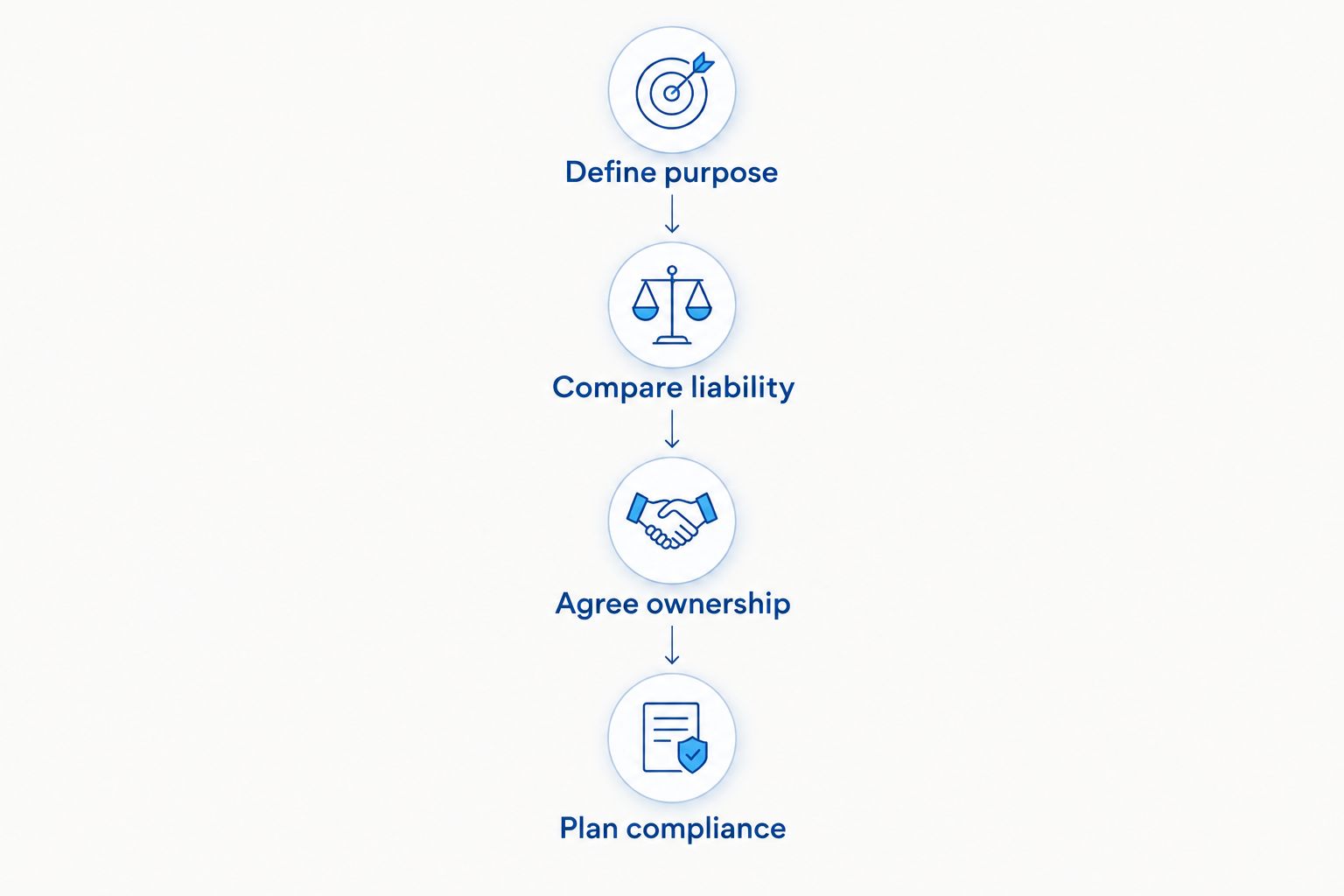
Use this sequence to turn the comparison into a decision.
Define purpose
Write down whether you intend to distribute profits to owners or apply income to a non-profit objective. Settle this first because it separates an NPC from the main commercial options.
Compare liability
List the obligations you expect to take on, including leases, borrowing and customer contracts. Ask a legal adviser to assess personal exposure, including any guarantees you will sign.
Agree ownership
Record who contributes money or assets and who receives ownership rights. For co-founders, agree approval rights and an exit process before filing registration documents.
Plan compliance
Assign responsibility for records, submissions and changes to ownership information. For your 2026 checklist, distinguish CIPC company obligations from SARS tax obligations and applicable labour registrations.
Express Reg's company registration and compliance services cover company formation and ongoing support. Ask for the scope of each service so you know which responsibilities remain with you as a director or business owner.
Choose a private company unless your needs point elsewhere
A Pty Ltd is the default recommendation for a startup that needs separate legal identity and ownership through shares. Choose a sole proprietorship if you will trade alone and accept personal liability; consider a partnership only after documenting the co-owners' arrangement.
Choose an NPC because your purpose requires its restrictions. A non-profit label does not replace a clear operating plan or tax assessment.
For a 2026 decision, review the structure before signing major commitments. Your first lease, shareholder arrangement or borrowing agreement can have consequences that registration documents alone will not address.
FAQ
Is a Pty Ltd the best business structure for a South African startup?
A Pty Ltd is the strongest default for founders who need separate legal identity and share ownership. A sole proprietorship, partnership or NPC fits different ownership, liability or purpose requirements.
Can I start a private company on my own?
Yes, a South African private company can have 1 shareholder and requires at least 1 director. The same person can hold both positions, while remaining responsible for the applicable company obligations.
Does a Pty Ltd protect my personal assets?
A Pty Ltd provides separate legal identity, but personal protection has limits. Personal guarantees, misconduct and statutory liabilities can expose a director or shareholder to personal claims.
Do I need to register a sole proprietorship with CIPC?
A sole proprietorship does not require incorporation as a company with CIPC. You must still assess SARS obligations and any licences, employment registrations or sector requirements that apply to your activity.
Is a partnership safer than a sole proprietorship?
An ordinary partnership does not remove personal liability for business obligations. Partners must also understand the authority each partner has to commit the business.
Can an NPC pay its founders?
An NPC can pay lawful remuneration for services, subject to the applicable requirements. Its income and property must serve its purpose, and founders cannot treat surplus funds as shareholder dividends.
Does buying a shelf company change the business structure?
Buying a shelf company transfers an existing company rather than creating a different legal structure. Check its records, ownership, directors and compliance position before proceeding.
One last thing
A company's age and its legal structure answer different questions. Buying a pre-registered company does not settle share allocation, director responsibilities or your tax and labour obligations.
Before you register or buy, write a short instruction stating the intended owners, business purpose and person responsible for compliance. Give that instruction to your legal, tax or registration adviser so the paperwork reflects the business you intend to run.