
The registrations needed for a security company in South Africa include PSiRA business registration, individual PSiRA registration for security personnel, and the tax and employer registrations that apply to your operation. Registering a company with CIPC does not authorise you to provide private security services.
- The registrations needed for a security company South Africa requires depend on business structure, staffing and services.
- PSiRA business registration and individual security officer registration serve different purposes; check both before deploying personnel.
- CIPC, SARS, UIF and Compensation Fund obligations remain separate from PSiRA approval.
- Express Reg supports company registration and compliance administration; government authorities decide registration applications.
For company formation and related compliance support, Express Reg serves entrepreneurs and established businesses. Express Reg is a private consultancy with no government affiliation.
Why these registrations matter
A security business has several compliance relationships. CIPC records companies, PSiRA regulates private security service providers, SARS administers taxes, and employment authorities oversee separate employer obligations.
For a 2026 launch, build your checklist around the work you will perform and the people you will employ. Complete the applicable regulatory approvals before accepting work that requires them. A client contract, company registration certificate or tax number cannot replace PSiRA registration.
Criteria for your registration checklist
The best checklist separates compulsory operating approvals from registrations triggered by your circumstances. Use these criteria before deciding which applications to prepare:
- Business structure: A private company follows a different formation process from a sole proprietor.
- Security activities: Identify the services you intend to provide before checking PSiRA requirements.
- People: Check the registration position of the business, responsible individuals and security officers.
- Employment: Hiring staff creates obligations beyond registering the business.
- Tax triggers: PAYE, SDL and VAT have distinct registration rules.
- Ongoing duties: Plan for returns, contributions and changes to registered information.
The ranking below follows these dependencies. The registrations perform different jobs, so you cannot choose one instead of another.
Security company registrations at a glance
| Registration | Best for | Main function | Key limitation |
|---|---|---|---|
| CIPC company registration | Establishing a private company | Creates the company as a legal entity | Does not authorise security services |
| PSiRA business registration | Authorisation to provide security services | Registers the security service provider | Does not replace individual registration |
| Individual PSiRA registration | Personnel compliance | Registers people performing regulated security work | Does not register their employer |
| SARS income tax registration | Company tax administration | Establishes the company's income tax record | Does not cover every employer tax |
| PAYE and SDL registration | Applicable payroll taxes | Records employer withholding and levy obligations | Each tax has its own registration tests |
| UIF registration | Employment-related unemployment insurance | Records the employer for UIF obligations | Requires continuing declarations and contributions |
| Compensation Fund registration | Occupational injury compliance | Registers an employer under COIDA | Does not replace workplace safety duties |
| VAT registration | Businesses meeting VAT registration rules | Establishes VAT accounting obligations | Turnover and other statutory tests apply |
| NBCPSS registration | Employers within the council's scope | Records participation in the sector bargaining framework | Scope and applicable agreements require checking |
1. CIPC registration: best for forming a private company
Choose CIPC company registration if you intend to operate through a South African private company. Decide who will own shares, who will act as directors and which registered details the company will use.
A shelf company also needs its ownership and director records brought into line with the transaction. Its existing incorporation does not establish security-sector approval.
CIPC pros:
- Establishes the company as a legal entity.
- Provides company information needed for other applications.
- Separates company administration from individual officer registration.
CIPC cons:
- Creates continuing statutory filing obligations.
- Provides no permission to deploy security officers.
Best for: Entrepreneurs choosing a private company structure.
Verdict: Hold security operations until the applicable PSiRA approvals are in place.
2. PSiRA business registration: best for security-sector authorisation
PSiRA business registration addresses the business's authority to provide private security services. Prepare the application against PSiRA's current business-registration checklist, including requirements affecting the business's directors, members, partners or other responsible persons.
Use the checklist applicable to your entity and activities in 2026. Do not rely on another operator's older application pack or assume that a company purchase transfers regulatory approval without further checks.
PSiRA business registration pros:
- Addresses the sector-specific operating requirement.
- Gives clients a registration record to verify.
- Connects business compliance to the responsible individuals.
PSiRA business registration cons:
- Requires an application separate from incorporation.
- Leaves tax, employment and individual registration duties outstanding.
Best for: Businesses preparing to provide regulated private security services.
Verdict: Hold regulated security work until PSiRA confirms the required business registration.
3. Individual PSiRA registration: best for personnel compliance
Check individual PSiRA registration before assigning security personnel to client work. Verify each person's registration and the training requirements relevant to the duties they will perform.
Business registration and individual registration answer different questions. The business needs its own compliant position, and the individuals performing regulated work need theirs.
Individual PSiRA registration pros:
- Provides a personnel-level compliance check.
- Supports verification before deployment.
- Helps you identify training or registration gaps during recruitment.
Individual PSiRA registration cons:
- Does not register the employing business.
- Requires checks beyond collecting an identity document or CV.
Best for: Businesses recruiting or deploying security officers.
Verdict: Hold deployment until you verify the individual's applicable registration and training.
4. SARS income tax registration: best for company tax administration
Check that SARS has registered the company for income tax and that you can access its tax affairs through the appropriate authorised representative. CIPC incorporation commonly initiates company income tax registration, but you still need to confirm the company's SARS record.
Keep the company name, registration details and representative information consistent. A tax reference number does not demonstrate that outstanding returns and tax obligations are up to date.
Income tax registration pros:
- Establishes the company's income tax account.
- Supports return submission and tax administration.
- Provides a foundation for managing the company's SARS affairs.
Income tax registration cons:
- Does not establish VAT or payroll tax registration.
- Requires continuing attention to returns and payments.
Best for: Companies establishing their tax administration.
Verdict: Hold assumptions about tax readiness until you check the SARS record and access.
5. PAYE and SDL: best for applicable payroll tax obligations
Assess PAYE registration before you start payroll. PAYE concerns employees' tax deductions; the Skills Development Levy, or SDL, follows separate liability and exemption rules.
Your 2026 payroll setup should record which employer taxes apply and why. Hiring a payroll administrator does not remove the employer's responsibility for accurate declarations and payments.
PAYE and SDL registration pros:
- Establishes the applicable employer tax accounts.
- Supports structured payroll deductions and reporting.
- Separates employee tax from the company's own income tax.
PAYE and SDL registration cons:
- Requires an assessment of the relevant registration rules.
- Adds recurring declarations and reconciliation work.
Best for: Employers whose payroll meets the applicable tax requirements.
Verdict: Hold the first payroll until you confirm the required employer tax setup.
6. UIF registration: best for unemployment insurance compliance
Assess UIF obligations as soon as you plan to employ staff. The standard contribution is 1% of qualifying remuneration from the employee and 1% from the employer, subject to the applicable remuneration ceiling and statutory exclusions.
The combined contribution is 2% of qualifying remuneration within those limits. Confirm whether your registration and payment route runs through SARS or the UIF, and maintain the required employee declarations.
UIF registration pros:
- Establishes the employer's UIF administration.
- Supports contributions linked to employees' benefit records.
- Gives payroll a defined contribution process.
UIF registration cons:
- Requires continuing employee information updates.
- Registration alone does not complete contribution or declaration duties.
Best for: Employers with employees covered by UIF legislation.
Verdict: Hold payroll sign-off until UIF deductions, employer contributions and reporting are configured.
7. Compensation Fund registration: best for occupational injury compliance
Employers must address registration under the Compensation for Occupational Injuries and Diseases Act, known as COIDA. For a security business, include Compensation Fund registration in the employment checklist rather than waiting for an injury.
Registration starts the administration process. You must also manage earnings declarations, assessments and occupational injury reporting as applicable.
Compensation Fund registration pros:
- Establishes the employer's compensation administration.
- Supports the statutory occupational injury claims process.
- Creates a basis for managing assessments and earnings reporting.
Compensation Fund registration cons:
- Requires continuing reporting and payment administration.
- Does not replace risk assessments, training or workplace safety duties.
Best for: Security businesses employing staff.
Verdict: Hold assumptions about COIDA compliance until registration and ongoing obligations are checked.
8. VAT registration: best for businesses meeting VAT rules
Check compulsory VAT registration against SARS's current taxable-turnover rules. Voluntary registration has its own conditions, so a client's request for a VAT invoice does not determine eligibility.
For a 2026 application, confirm the rules in force before setting your invoicing process. Registering for VAT brings obligations involving tax invoices, records, returns and payments.
VAT registration pros:
- Establishes VAT administration where required or permitted.
- Supports compliant VAT invoicing after registration takes effect.
- Allows input tax deductions where statutory requirements are met.
VAT registration cons:
- Creates recurring accounting and return obligations.
- Requires eligibility checks rather than a blanket startup application.
Best for: Businesses meeting compulsory or voluntary VAT registration conditions.
Verdict: Hold any VAT charge until you confirm the registration's effective date and requirements.
9. NBCPSS registration: best for sector employment compliance
Check whether your business falls within the registered scope of the National Bargaining Council for the Private Security Sector, or NBCPSS. Employers within scope must address council registration and the applicable collective-agreement obligations.
Treat this as a separate employment compliance check. PSiRA registration does not settle bargaining council requirements, remuneration rules or applicable employee benefit obligations.
NBCPSS registration pros:
- Establishes the employer's council administration where required.
- Connects payroll planning to applicable sector agreements.
- Helps identify obligations before you quote for labour-intensive contracts.
NBCPSS registration cons:
- Requires a scope assessment against your activities.
- Adds obligations beyond general payroll tax registration.
Best for: Employers operating within the council's registered scope.
Verdict: Hold staffing cost approval until you confirm applicable council and collective-agreement obligations.
Prepare applications in a workable order
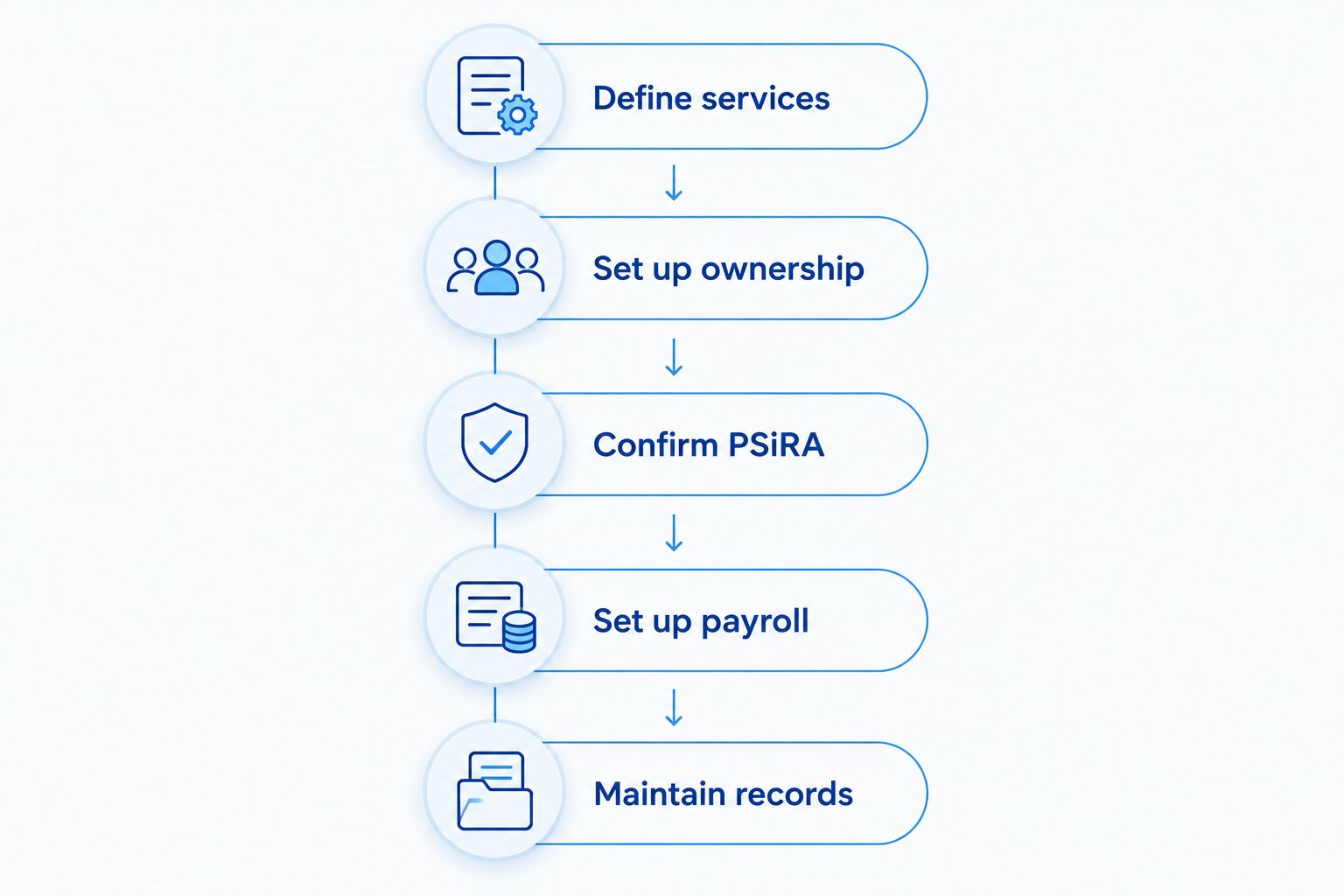
For your 2026 launch, organise the work into these stages. Some applications can run alongside others, but check the supporting documents each authority requires before submitting.
- Define services: Record your intended activities and assess any additional approvals, including firearm-related requirements for armed services.
- Set up ownership: Choose the business structure and prepare the relevant company, ownership and responsible-person records.
- Confirm PSiRA: Prepare business and individual registration checks against current requirements.
- Set up payroll: Assess SARS employer taxes, UIF, COIDA and bargaining council obligations.
- Maintain records: Assign responsibility for returns, payments, staff changes and registration updates.
Keep submission receipts separate from approval records. An application acknowledgement confirms submission; it does not establish that the authority has approved the application.
Basis for the registration order
The order starts with the legal entity and sector authorisation, then covers personnel, tax and employment administration. Your actual application sequence depends on the documents each authority requests and the activities you intend to undertake.
Express Reg provides company registration and compliance services for entrepreneurs who need administrative support. Confirm the assignment's scope before appointing a provider, including which applications you must handle through the relevant authority.
Your starting point
Prioritise PSiRA requirements alongside company formation, then map employer and tax registrations to your staffing plan. Choose support based on the specific applications involved rather than a package name.
Plan your company registration
Discuss company formation and compliance support with a private business services consultancy.
FAQ
Do I need PSiRA registration if I have a CIPC certificate?
Yes, a CIPC certificate does not replace the PSiRA registration required to provide private security services. Check the business registration requirements and the individual requirements affecting your personnel.
Can I start deploying guards while my application is pending?
A pending application does not establish approval to provide regulated security services. Confirm the required business and individual registrations before deployment.
Does buying a shelf company cover security company registration?
Buying a shelf company does not establish that you have the required security-sector approvals. Check company records, PSiRA registration and the changes required for the transaction.
Do my security officers need their own PSiRA registration?
Security officers performing regulated security work need the applicable individual PSiRA registration. Verify registration and relevant training before assigning duties.
Do I need VAT registration before starting a security company?
VAT registration depends on the applicable compulsory or voluntary registration rules. Check your taxable turnover and eligibility against current SARS requirements.
Does PSiRA registration cover UIF and COIDA?
PSiRA registration does not cover UIF or COIDA obligations. Assess employer registrations and maintain the declarations, contributions and reporting that apply.
Can Express Reg issue government approval for my security company?
Express Reg is a private business services consultancy and has no government affiliation. The relevant authorities decide registration applications and issue their approvals.
One last thing
Check the registration position before signing a client contract that commits you to a deployment date. Put responsibility for renewals, returns and personnel verification into your operating procedures, alongside recruitment and payroll.
A complete launch file should let you distinguish company formation, security authorisation and employer compliance without treating one certificate as proof of all three.