
Grade 1 is the starting point for contractors without an established project record; higher grades suit contractors who can prove the required financial and works capability. This guide to CIDB registration grades for contractors South Africa compares all nine grades so you can choose a realistic application route for your contracting business.
- CIDB registration grades for contractors South Africa run from Grade 1 to Grade 9, with separate classes of works.
- Choose Grade 1 for an entry-level application; apply for higher grades using evidence of financial and works capability.
- Grade 9 has no upper tender-value limit, but the tender's other eligibility conditions still apply.
- Express Reg supports company registration and compliance; CIDB determines contractor grading.
Why your CIDB grade matters
Your CIDB grading designation helps determine the public-sector construction contracts for which you qualify. A higher grade does not replace the correct class of works, tax compliance or the tender's technical requirements.
Express Reg helps entrepreneurs with company registration and ongoing compliance. Keep that work separate from your CIDB assessment: CIPC registers your company, SARS administers tax, and CIDB registers and grades contractors.
For a 2026 tender submission, check the published tender conditions against your current registration. A company registration certificate alone does not establish your eligibility to bid.
Criteria for choosing a CIDB registration grade
Assess these requirements before choosing a grade:
- Tender value: Match the proposed contract to CIDB's current tender-value limits for your grade.
- Class of works: Choose the construction category that matches the work you perform, such as general building or civil engineering.
- Financial capability: Use the financial records required for the grade you seek.
- Works capability: Support your application with the project evidence CIDB requires.
- Delivery capacity: Check whether your people, equipment, working capital and subcontracting arrangements support the proposed work.
Apply for the grade your evidence supports, then target contracts within that designation. A desired tender value does not establish your qualification for the corresponding grade.
CIDB registration grades at a glance
The table follows the grading ladder rather than ranking higher grades as better businesses. The right choice depends on your evidence and intended contracts.
| Grade | Best for | Main advantage | Main limitation |
|---|---|---|---|
| Grade 1 | Entry-level contractors | Starting point without the higher grades' financial and works assessment | Lowest tender-value band |
| Grade 2 | Contractors making their first supported upgrade | First step beyond entry-level registration | Requires evidence supporting the higher grade |
| Grade 3 | Contractors targeting work above Grade 2 | Access to the next tender-value band | Does not cover contracts requiring Grade 4 or above |
| Grade 4 | Contractors progressing beyond Grade 3 | Higher tender-value ceiling | Larger contracts remain outside the grade |
| Grade 5 | Contractors targeting the next stage of growth | Higher band than Grade 4 | Financial and works evidence must support the application |
| Grade 6 | Contractors progressing beyond Grade 5 | Access to a higher contract-value band | Does not establish eligibility for Grade 7 tenders |
| Grade 7 | Contractors targeting larger contracts | Higher tender-value ceiling than Grade 6 | Requires supporting capability, not ambition alone |
| Grade 8 | Contractors below the unlimited-value tier | Highest grade with a defined upper tender-value limit | An upper limit still applies |
| Grade 9 | Contractors qualified for the unlimited-value tier | No upper tender-value limit | Other tender and capability requirements remain |
Use CIDB's current published limits for a 2026 application. The table explains the decision between grades without replacing the official financial and works capability assessment.
1. Grade 1: best for entry-level contractors
Grade 1 suits a contractor starting without the established financial and project evidence needed for higher grades. It gives you an entry point into the register within the lowest tender-value band.
Choose the correct class of works at the outset. Grade 1 general building registration and Grade 1 civil engineering registration cover different work categories.
Grade 1 pros:
- Provides an entry-level registration route.
- Avoids applying for a higher grade before you can support it.
- Gives you a defined band for selecting suitable tenders.
Grade 1 cons:
- Restricts you to the lowest tender-value band.
- Does not remove tender-specific eligibility requirements.
Best for: New contractors building a documented delivery record.
Verdict: Choose Grade 1 if you cannot substantiate a higher grade.
2. Grade 2: best for a first supported upgrade
Grade 2 is the next step above entry-level registration. Apply once your financial and works evidence meets CIDB's requirements for that grade.
Review your completed-project records before choosing this route. A larger pipeline of potential work does not prove completed works capability.
Grade 2 pros:
- Opens the next tender-value band above Grade 1.
- Supports a measured progression from entry-level work.
- Gives you a defined target for preparing an upgrade application.
Grade 2 cons:
- Requires evidence beyond an entry-level application.
- Still excludes contracts above its tender-value limit.
Best for: Grade 1 contractors whose records support their first upgrade.
Verdict: Choose Grade 2 once your evidence supports the move.
3. Grade 3: best for contracts beyond Grade 2
Grade 3 suits contractors targeting a tender-value band above Grade 2. The application still depends on financial and works capability in the relevant class.
Start with the contracts you intend to pursue. Then check whether Grade 3 covers their values and whether your records meet the assessment requirements.
Grade 3 pros:
- Covers a higher tender-value band than Grade 2.
- Supports growth without assuming eligibility for substantially larger work.
- Keeps your target contracts tied to a defined ceiling.
Grade 3 cons:
- Does not qualify you for contracts requiring a higher grade.
- Requires supporting records for the relevant works category.
Best for: Contractors whose target work has outgrown Grade 2.
Verdict: Choose Grade 3 for a supported step above Grade 2.
4. Grade 4: best for progression beyond Grade 3
Grade 4 provides a higher tender-value ceiling than Grade 3. It suits a contractor whose evidence and target contracts support that next step.
Assess delivery requirements as well as registration eligibility. A larger contract can place greater demands on procurement, site supervision and working capital.
Grade 4 pros:
- Expands the contract-value band available to qualified applicants.
- Provides a defined progression from Grade 3.
- Helps you filter tenders by the required grading designation.
Grade 4 cons:
- Leaves higher-value contracts outside your grading ceiling.
- Does not prove that your business can fund a particular project.
Best for: Contractors progressing beyond Grade 3 with supporting records.
Verdict: Choose Grade 4 if both your evidence and delivery plan support it.
5. Grade 5: best for growth beyond Grade 4
Grade 5 covers a higher tender-value band than Grade 4. Select it because it fits your qualifying evidence and planned contracts, rather than as a general sign of business status.
Check the tender's class of works before preparing a bid. A sufficient grade in the wrong class does not meet a requirement for another class.
Grade 5 pros:
- Raises the tender-value ceiling above Grade 4.
- Supports access to contracts in the next band.
- Provides a defined qualification target for business planning.
Grade 5 cons:
- Requires the relevant financial and works capability evidence.
- Does not replace the tender's technical assessment.
Best for: Contractors ready to pursue work beyond Grade 4 limits.
Verdict: Choose Grade 5 for eligible work that exceeds Grade 4.
6. Grade 6: best for progression beyond Grade 5
Grade 6 suits contractors whose qualifying evidence supports the band above Grade 5. Review your financial information and project records together before applying.
For your 2026 contracting plan, separate registration eligibility from project funding. Your grade does not guarantee that a lender, supplier or client will accept your commercial arrangements.
Grade 6 pros:
- Opens a higher tender-value band than Grade 5.
- Supports bids requiring the corresponding grading designation.
- Gives you a clear boundary for screening opportunities.
Grade 6 cons:
- Does not cover tenders requiring Grade 7 or above.
- Does not remove project-specific funding and delivery risks.
Best for: Contractors with evidence supporting progression beyond Grade 5.
Verdict: Choose Grade 6 after checking capability and funding separately.
7. Grade 7: best for larger-contract progression
Grade 7 provides a higher tender-value ceiling than Grade 6. Contractors should assess the requirements against their own records before committing to an application.
Keep evidence linked to the legal entity applying for registration. Do not assume that a director's previous employment history proves the applicant company's completed works.
Grade 7 pros:
- Covers a higher contract-value band than Grade 6.
- Supports qualification for tenders requiring Grade 7.
- Provides a defined step towards the upper grading tiers.
Grade 7 cons:
- Still has an upper tender-value limit.
- Requires evidence attributable to the applicant under CIDB's rules.
Best for: Contractors whose qualifying records support larger-contract progression.
Verdict: Choose Grade 7 using evidence the applicant can substantiate.
8. Grade 8: best for the highest capped tier
Grade 8 is the highest CIDB grade with an upper tender-value limit. It suits contractors whose intended work and qualifying evidence fit this tier.
Confirm the tender value against the current ceiling before bidding. A Grade 8 designation does not provide unrestricted access to contracts of any value.
Grade 8 pros:
- Provides access to the highest capped tender-value band.
- Supports bids specifying Grade 8 in the relevant class.
- Offers a clear distinction from the unlimited-value tier.
Grade 8 cons:
- Retains an upper tender-value limit.
- Does not replace tender-specific experience or resource requirements.
Best for: Qualified contractors targeting the highest capped band.
Verdict: Choose Grade 8 if its ceiling covers your intended contracts.
9. Grade 9: best for contracts without a grading ceiling
Grade 9 has no upper tender-value limit. Contractors must still meet CIDB's qualification requirements and the conditions of each tender.
The unlimited ceiling concerns contract value. Clients still assess the technical, commercial and other eligibility requirements stated in their procurement documents.
Grade 9 pros:
- Removes the upper tender-value ceiling attached to lower grades.
- Supports bids requiring Grade 9 in the relevant class.
- Accommodates qualifying contracts beyond Grade 8 limits.
Grade 9 cons:
- Requires supporting financial and works capability.
- Provides no guarantee of tender success or delivery capacity.
Best for: Qualified contractors pursuing work beyond the capped tiers.
Verdict: Choose Grade 9 only when your evidence supports that tier.
Prepare your grading decision
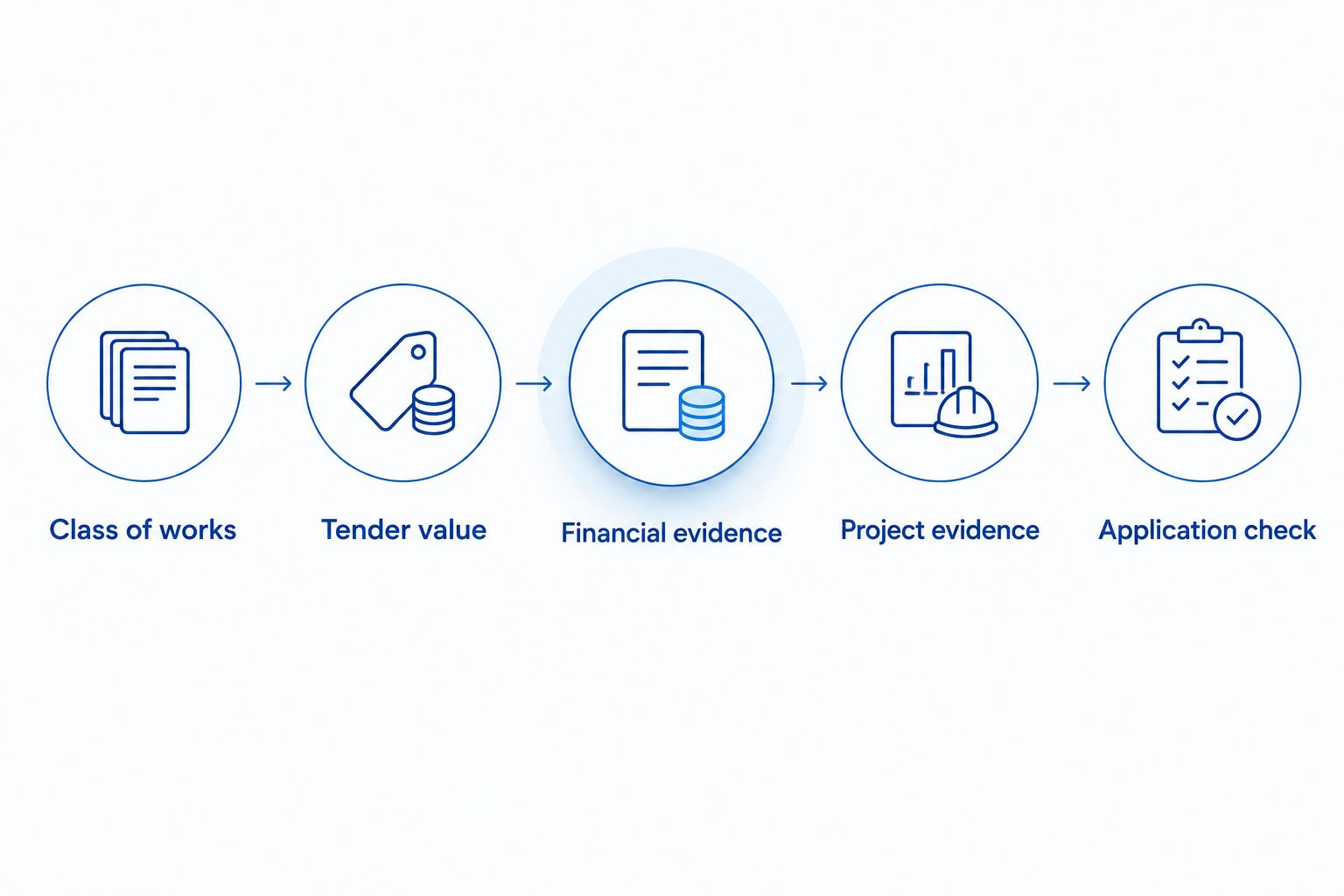
Use this sequence before submitting a 2026 application:
- Class of works: Identify the category matching your construction activity.
- Tender value: Compare intended contracts with CIDB's current limits.
- Financial evidence: Assemble the records required for your target grade.
- Project evidence: Check that your works records support the application.
- Application check: Confirm the current forms, supporting documents and submission requirements.
Keep these checks in the same application file. A mismatch between the class, tender value and supporting records needs attention before submission.
Basis for these recommendations
The recommendations follow CIDB's grading ladder, tender-value limits and financial and works capability framework. The order starts with entry-level registration and ends with the unlimited-value tier; it does not rank contractors by service quality.
Use CIDB's contractor registration guidance as the authority for a 2026 submission. Check the current requirements before acting on a grade comparison.
Choose the grade your records support
Grade 1 is the default starting point if you lack evidence for a higher grade. Contractors with qualifying records should select the grade that covers their intended contracts in the correct class of works.
Express Reg is best for entrepreneurs who need company registration and compliance support alongside their contracting plans. Express Reg is a private consultancy, not a government authority; CIDB determines contractor registration and grading.
FAQ
Is Grade 1 the best CIDB grade for a new contractor?
Grade 1 is the starting point for contractors without evidence supporting a higher grade. Select the correct class of works and check the tender's remaining eligibility conditions.
Can I apply for a higher CIDB grade without starting at Grade 1?
You can apply for a higher grade if you meet CIDB's requirements for that grade. Your application must support the required financial and works capability.
Does Grade 9 let me tender for any construction contract?
Grade 9 has no upper tender-value limit, but you must still meet the tender's other conditions. The correct class of works, technical requirements and eligibility criteria remain relevant.
Are CIDB grades and classes of works the same?
CIDB grades and classes of works describe different requirements. The grade relates to your grading level and tender-value band, while the class identifies the construction work category.
Does registering a company give me CIDB registration?
Company registration does not give you CIDB registration. CIPC company registration and CIDB contractor registration are separate processes.
Can buying a shelf company give me a higher CIDB grade?
Buying a shelf company does not establish qualification for a higher CIDB grade. Company age alone does not prove the required financial and works capability.
Does a higher CIDB grade guarantee that I will win tenders?
A higher CIDB grade does not guarantee a tender award. The client assesses bids against the conditions and evaluation criteria in the tender documents.
One last thing
Preserve your project evidence as you complete work. Keep contracts, completion records and relevant financial documents organised so you can assess a future upgrade using records rather than recollection.
Before buying an existing company, check its registration and compliance records separately from its incorporation date. An older company does not establish a stronger CIDB application through age alone.