
South African companies’ beneficial ownership compliance is the identification and disclosure of the natural persons who own or control a business, with the aim of meeting CIPC requirements. The beneficial ownership CIPC deadline depends on the filing trigger: 10 business days after incorporation, 10 business days after a change in beneficial ownership information, and an annual declaration alongside the annual return filing cycle.
- The beneficial ownership CIPC deadline follows incorporation, ownership changes and annual returns, rather than one national filing date.
- New entities must file beneficial ownership information within 10 business days after incorporation.
- Annual returns fall due within 30 business days after the incorporation anniversary; keep the beneficial ownership declaration current.
- Express Reg suits business owners seeking assistance with CIPC compliance filings and ongoing administration.
Why beneficial ownership compliance matters for business owners
CIPC requires information about the natural persons behind a registered entity. A company name in a share register does not complete that enquiry if another person ultimately owns or controls the shareholder.
For your 2026 compliance calendar, separate incorporation, ownership changes and annual returns. Each trigger needs its own check. Waiting for the annual return does not satisfy an earlier obligation to report a change.
You can manage the process yourself through CIPC or appoint a service provider. Express Reg provides company registration and compliance services for businesses that want administrative support. Express Reg is a private consultancy, with no affiliation to a government authority.
Express Reg is best for business owners seeking assistance with CIPC compliance administration. You still need to provide accurate ownership information and supporting records, regardless of who submits the declaration.
Establish which deadline applies to your entity
CIPC’s beneficial ownership filing guidance distinguishes between initial declarations, changes and annual compliance. Its annual return guidance sets the annual return filing window by reference to the entity’s incorporation anniversary. Use those triggers to organise your 2026 filing schedule.
| Filing trigger | Relevant deadline | Action for the owner or director |
|---|---|---|
| Incorporation of a new entity | Within 10 business days after incorporation | Identify beneficial owners and submit the required declaration |
| Change in beneficial ownership information | Within 10 business days after the change | Update the underlying records and submit the changed information |
| Annual return cycle | Annual returns fall due within 30 business days after the incorporation anniversary | Complete the required annual beneficial ownership declaration and annual return process |
There is no single beneficial ownership CIPC deadline that applies to all businesses in 2026. Your incorporation date, subsequent changes and annual compliance cycle determine the relevant dates.
Business days exclude weekends and public holidays. Calculate the period using the applicable South African calendar, and keep the event date beside the filing deadline in your records. Avoid treating a business-day deadline as the same number of calendar days.
Confirm whether your entity must file
Companies and close corporations fall within CIPC’s beneficial ownership reporting framework. The filing route and supporting register depend on the entity’s legal classification, including whether a company qualifies as an affected company.
An affected company follows the applicable beneficial interest and securities register requirements. A non-affected company follows the beneficial ownership declaration requirements. Confirm the classification before preparing the submission, because the same document set does not suit all entities.
A non-profit company also needs an ownership-and-control assessment. The absence of shareholders does not settle the question of which natural persons exercise effective control.
A sole proprietor does not file a company beneficial ownership declaration merely because they run a business. Establish the legal entity first, then apply its obligations.
Complete your beneficial ownership filing
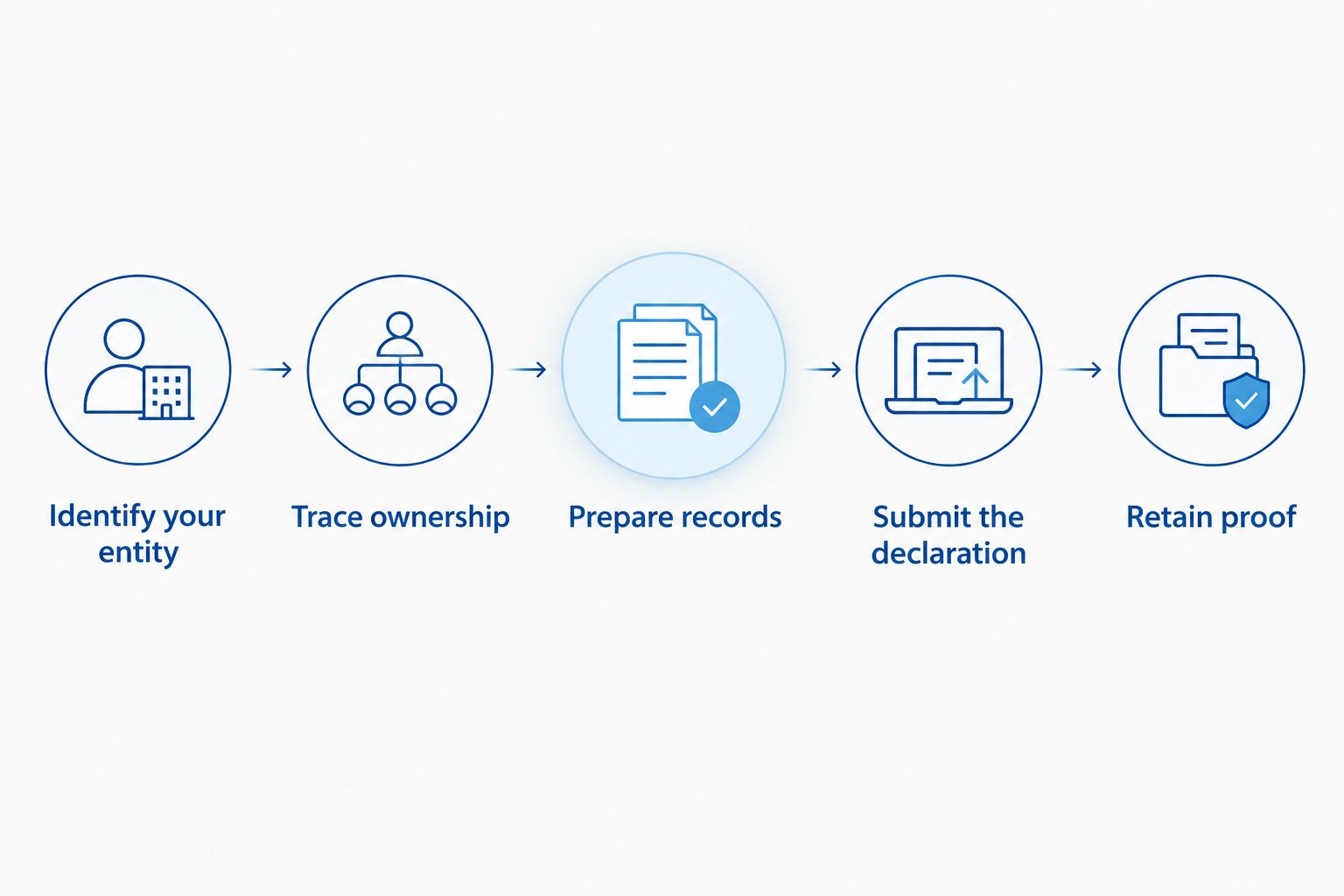
Identify your entity and filing trigger
Start with your registration certificate, current CIPC disclosure information and previous filing acknowledgements. Record the incorporation date and establish whether you are handling an initial declaration, a change or an annual declaration.
For an established business, check the last accepted submission against current facts. A previous filing confirms what you submitted at that time; it does not prove that later ownership changes have reached CIPC.
Use a short filing record that you can hand to another director or administrator without a verbal explanation.
- Record the registered entity name and registration number.
- Identify the incorporation anniversary and relevant ownership changes.
- Classify the task as an initial, changed-information or annual filing.
- Calculate and record the applicable business-day deadline.
Trace ownership and control to natural persons
Build an ownership chart using your securities register, member information and relevant agreements. Follow corporate shareholders through the ownership chain until you identify the natural persons who ultimately own or exercise effective control.
Directors and beneficial owners are different concepts. A director’s appointment alone does not establish beneficial ownership, while a person who controls an entity through other arrangements still needs assessment.
Avoid relying on a trading name, bank signatory list or a verbal description of the business. Those records do not replace an assessment of ownership and control.
- List direct shareholders or members from the relevant register.
- Trace ownership through companies and other legal arrangements.
- Review voting rights and agreements that confer control.
- Document the basis for identifying each beneficial owner.
Prepare the correct records and authority
Check CIPC’s requirements for your entity type before assembling the filing documents. Prepare the relevant ownership register, identity information and authority for the person who will submit the declaration.
If you appoint a representative, agree who will collect missing documents, confirm the information and retain the acknowledgement. Express Reg offers CIPC compliance support, but you must still confirm the underlying facts and supply the records needed for your submission.
The service route reduces the administration you handle yourself. It does not transfer responsibility for the truth of your ownership information to the filing platform or representative.
- Prepare the register required for your entity’s classification.
- Check names and identity details against supporting documents.
- Obtain the filing authority required for your representative.
- Resolve inconsistencies before submitting the declaration.
Submit the declaration and retain proof
Use CIPC’s filing process to submit the declaration and supporting information. Check the entity selection before you upload documents, particularly if you administer several companies.
Review the submission outcome rather than treating an upload as completion. A rejected filing needs correction; a payment record or email conversation with a representative does not replace evidence of the filing outcome.
Keep the acknowledgement with the records that supported the declaration. That gives you a clear reference point for the next annual review or ownership change.
- Select the correct registered entity before submission.
- Review the declared owners and control information.
- Check the submission status and address rejection messages.
- Save the acknowledgement and submitted supporting records.
Connect changes to your annual compliance calendar
Create separate reminders for event-driven updates and annual compliance. A share transfer, control agreement or change to declared beneficial owner information needs review when it happens, rather than at the next anniversary.
For the 2026 annual cycle, compare the current ownership position with the last declaration before proceeding with annual returns. CIPC links beneficial ownership compliance to the annual return process, so leaving that check until the end creates an avoidable obstacle.
Keep the calendar visible to the person who handles statutory administration. Directors, shareholders and the administrator need a clear way to communicate changes.
- Record ownership and control changes as they occur.
- Assess changed information against the 10-business-day requirement.
- Review beneficial ownership before the annual return submission.
- Allocate responsibility for reminders and proof of completion.
Resolve overdue or rejected filings
Check the entity’s current CIPC status and filing history before deciding what to submit. Separate an outstanding beneficial ownership declaration from outstanding annual returns, because completing one task does not prove completion of the other.
Prepare accurate current information and resolve the recorded filing issue. Avoid backdating documents or entering an assumed ownership position to move through the process.
If the company faces deregistration action or has already been deregistered, establish the applicable status and procedure before treating the matter as a routine declaration. A beneficial ownership submission alone does not resolve all company-status problems.
- Identify the outstanding declaration or rejected submission.
- Reconcile the ownership records before correcting the filing.
- Check annual returns and company status as separate tasks.
- Retain proof of each completed correction.
The filing sequence starts with the legal entity and ends with retained evidence. Keep the same sequence whether you submit yourself or appoint a representative.
Compare filing options for your business
Choose your filing route according to your ownership structure and your capacity to maintain records. A straightforward structure still needs accurate information; a layered structure needs more work before anyone enters information into CIPC.
| Option | Best for | Main advantage | Key limitation |
|---|---|---|---|
| Direct CIPC submission | Owners who understand their entity’s ownership and filing requirements | You control the preparation, submission and record storage | You must identify the correct filing route and resolve submission issues |
| Express Reg compliance support | Owners who want help with CIPC administration | You can obtain support with statutory filings and ongoing compliance | You must provide accurate facts, documents and filing authority |
| Legal or accounting advice before submission | Businesses with layered ownership, trusts or disputed control | You can resolve ownership or control questions before declaring them | Advice and submission are separate tasks unless the engagement covers both |
Choose administrative support for a filing workload, and seek appropriate professional advice for an unresolved ownership question. Submitting an uncertain answer faster does not correct it.
Before instructing a provider, ask which records they need and what evidence you will receive after submission. Confirm whether the engagement covers only the declaration or also includes related annual compliance work.
Common mistakes business owners make
Treating the annual return date as the only deadline
Annual compliance does not replace the initial or changed-information filing requirement. Record the incorporation or change date as soon as the event occurs, then calculate its deadline separately from the annual return window.
Assuming a director list proves beneficial ownership
The director list identifies officeholders. Your beneficial ownership assessment must examine the natural persons who ultimately own or exercise effective control, including through an ownership chain or relevant agreement.
Leaving a shelf company’s old information in place
A pre-registered company still needs current ownership and control records. Check the handover documents, the effective dates of changes and the previous declarations instead of assuming the purchase completed the compliance work.
Treating an upload as an accepted filing
A submission can require correction. Keep the filing outcome and address rejection messages, rather than closing the task because someone uploaded documents or sent an instruction email.
Confusing CIPC compliance with SARS compliance
CIPC beneficial ownership declarations and SARS tax obligations serve different purposes. Keep separate records for company filings and tax registrations so that completing one process does not obscure another outstanding obligation.
FAQ
Is there one beneficial ownership CIPC deadline for all companies in 2026?
No, the deadline depends on the filing trigger. Initial declarations, changes to beneficial ownership information and the annual return cycle have separate timing requirements.
Do I need to file beneficial ownership after registering a company?
Yes, a new entity must submit its beneficial ownership information within 10 business days after incorporation. Prepare the ownership assessment and supporting records as part of your registration follow-up.
Do I have to update CIPC after a beneficial owner changes?
Yes, changes in beneficial ownership information must reach CIPC within 10 business days after the change. Update the supporting records and retain proof of the submission.
Can I wait until annual returns to declare an ownership change?
No, the change-reporting deadline applies separately from annual returns. Annual returns fall due within 30 business days after the incorporation anniversary, but that window does not extend an earlier change-reporting deadline.
Does a company without trading activity still need to file?
A lack of trading activity does not itself remove beneficial ownership reporting obligations. Check the registered entity’s status and applicable requirements rather than using turnover or inactivity as an exemption.
Are directors and beneficial owners the same people?
Directors and beneficial owners are different categories, although a person can fall into both. Assess ultimate ownership and effective control instead of copying the director list into the declaration.
Can a representative submit the declaration for me?
A representative can assist with the filing when you provide the required authority and supporting information. Confirm who will review the declaration, resolve submission issues and retain the filing acknowledgement.
One last thing
Add an ownership-reporting requirement to your internal share-transfer process. Ask the person handling the transaction to notify the compliance administrator of the effective date and supply the updated records, so the business can assess the filing deadline without waiting for an annual reminder.