
Start with PAYE and UIF assessments, add SDL if your payroll creates a liability, and assess Compensation Fund registration separately from VAT. This guide explains tax registrations for new employers in South Africa for 2026, with Express Reg providing registration and compliance support for businesses that need administrative help.
- Tax registrations for new employers in South Africa start with PAYE, UIF and SDL eligibility checks.
- Express Reg suits employers seeking administrative support with tax and labour registrations.
- Compensation Fund registration addresses occupational injuries and diseases; VAT addresses taxable business supplies.
- Registration does not replace payroll calculations, monthly submissions or payment obligations.
Why employer registrations need separate checks
Hiring an employee creates several compliance questions. SARS administers PAYE and SDL, while UIF administration involves SARS or the Department of Employment and Labour, depending on your circumstances. The Compensation Fund has a separate registration process.
Your company registration does not settle these obligations. Your legal structure also affects the taxpayer responsible for business income, so confirm your business structure for a South African start-up before submitting applications under the wrong person or entity.
For 2026 planning, use SARS guidance on employer registration, employees’ tax, SDL and UIF, alongside Department of Employment and Labour guidance on UIF and Compensation Fund registration. These authorities administer different duties. A successful submission to one does not confirm compliance with another.
Assessment criteria for employer registrations
These registrations serve different legal purposes. The ranking below gives you an assessment order, rather than a choice between competing products.
- Legal trigger: Identify the employment, remuneration or business activity that creates the obligation.
- Correct authority: Confirm whether SARS, the UIF or the Compensation Fund handles the application.
- Payroll connection: Separate deductions from employees from contributions paid by the employer.
- Ongoing administration: Identify the returns, declarations and records that follow registration.
- Evidence: Keep registration confirmations and submission receipts against the correct entity.
Express Reg is best suited to employers seeking administrative support with tax and labour registrations. Your business still needs to supply accurate information and arrange the calculations, declarations and payments that apply.
Employer registrations at a glance
| Priority | Registration | Best for | Main purpose | Key limitation |
|---|---|---|---|---|
| 1 | PAYE | Employers paying remuneration subject to employees’ tax | Registers the employer for employees’ tax administration | Registration does not calculate each employee’s deduction |
| 2 | UIF | Employers with employees covered by UIF | Supports unemployment insurance contributions and declarations | Coverage exclusions and registration routes need separate checks |
| 3 | SDL | Employers whose expected leviable payroll exceeds the exemption threshold | Establishes the employer’s skills development levy obligation | The employer pays the levy; it is not an employee deduction |
| 4 | Compensation Fund | Employers needing occupational injury and disease cover | Registers the employer under COIDA | Separate assessments and reporting duties continue after registration |
| 5 | VAT | Businesses meeting VAT registration conditions | Addresses VAT on taxable supplies | Hiring staff does not itself trigger VAT registration |
1. PAYE: first assessment for taxable employee remuneration
Best for: employers paying remuneration that creates an employees’ tax obligation. PAYE means Pay-As-You-Earn. Employers deduct employees’ tax from applicable remuneration and account for it to SARS.
SARS states that an employer must register within 21 business days after becoming an employer, unless none of its employees is liable for normal tax. Assess that requirement against the remuneration you will pay, rather than assuming that a small team creates an exemption.
For 2026 payroll, use the SARS tax tables applicable to the payment period. An employee’s tax position depends on more than their job title or whether you describe the role as temporary.
PAYE benefits
- Establishes the employer’s employees’ tax registration with SARS.
- Supports the administration of payroll deductions and employer declarations.
- Gives you a defined registration record to use in payroll administration.
PAYE limitations
- Registration does not determine taxable remuneration or perform payroll calculations.
- Employers must continue with applicable declarations, payments and reconciliations.
Before the first payroll, establish who calculates deductions and who submits the employer declarations. Confirm access to the relevant SARS profile and keep the registration confirmation with your payroll records.
Verdict: prioritise the PAYE assessment before paying remuneration, and register when the legal requirement applies.
2. UIF: priority check for covered employees
Best for: employers whose employees fall within UIF coverage. UIF provides benefits under unemployment insurance legislation. Employers must assess coverage even where an employee has no PAYE deduction.
For covered remuneration, the standard contribution is 1% from the employee and 1% from the employer, subject to the applicable remuneration ceiling. The combined contribution is 2%. Do not deduct the employer’s share from the employee’s pay.
The Department of Employment and Labour identifies employees working fewer than 24 hours per month for an employer among the exclusions. Check the other statutory exclusions and the applicable registration route before applying that rule to your workforce.
UIF benefits
- Supports statutory unemployment insurance contributions for covered employees.
- Creates a registration basis for the employer’s UIF administration.
- Separates the employer’s contribution from the employee’s deduction.
UIF limitations
- UIF coverage does not follow an employee’s PAYE position.
- Registration alone does not maintain employee declarations or contribution records.
For your 2026 payroll setup, confirm whether your UIF registration and payments belong through SARS or the UIF’s own administration. Keep employee details consistent across payroll and declarations, particularly identity details, employment dates and remuneration.
Verdict: assess UIF independently of PAYE, then confirm the correct registration and declaration route.
3. SDL: conditional registration for a larger payroll
Best for: employers whose expected leviable payroll exceeds the SDL exemption threshold. The Skills Development Levy is an employer levy administered by SARS. An employer generally qualifies for the payroll exemption if expected leviable remuneration over the next 12 months does not exceed R500,000, subject to the statutory rules.
The standard SDL rate is 1% of leviable remuneration. The employer pays this levy; payroll must not treat it as a deduction from employees’ wages.
Assess your expected payroll rather than using only your first month’s wages. Planned recruitment and remuneration changes belong in that assessment.
SDL benefits
- Establishes the registration needed where the levy applies.
- Makes the employer’s levy obligation visible in payroll administration.
- Encourages a forward-looking assessment of leviable remuneration.
SDL limitations
- The levy creates an employer expense separate from employee deductions.
- SDL registration does not itself secure a training grant or complete SETA requirements.
Keep a dated record of the payroll forecast supporting your decision. Reassess the exemption as recruitment plans change, rather than carrying an initial decision through a growing payroll without review.
Verdict: register if liable; keep the exemption assessment on file if your business qualifies.
4. Compensation Fund: separate occupational injury registration
Best for: employers requiring registration under the Compensation for Occupational Injuries and Diseases Act, known as COIDA. Compensation Fund registration deals with occupational injuries and diseases. It is a labour compliance obligation, not a SARS payroll tax registration.
The Department of Employment and Labour states that employers must register within 7 days after appointing an employee. Confirm the applicable arrangement if your business falls under a licensed mutual association or another statutory exception.
Do not treat an office-based workforce as a reason to ignore the assessment. The registration question follows the legislation and your employment arrangements.
Compensation Fund benefits
- Establishes the employer’s registration under the applicable compensation system.
- Supports the administration of occupational injury and disease claims.
- Creates a basis for the employer’s assessment and reporting duties.
Compensation Fund limitations
- Registration does not replace workplace health and safety duties.
- Employers must maintain required reporting, earnings returns and assessment payments.
Assign responsibility for reporting workplace incidents and submitting the required earnings information. Keep the employer’s registration details available to the person responsible for these duties, rather than leaving them only in an application email.
Verdict: assess Compensation Fund registration alongside payroll setup, using a separate compliance checklist.
5. VAT: business activity check rather than a hiring trigger
Best for: businesses that meet compulsory VAT registration conditions or qualify for voluntary registration. VAT concerns taxable supplies made by the business. Your decision to employ someone does not, on its own, create a VAT registration obligation.
Assess VAT against SARS requirements for your supplies and turnover. Separate that assessment from PAYE, UIF and SDL so that an employer registration application does not create a false sense that all tax registrations are complete.
VAT benefits
- Establishes the business’s VAT status where registration applies.
- Allows a registered vendor to claim qualifying input tax, subject to the rules.
- Clarifies the VAT treatment required on relevant business transactions.
VAT limitations
- Vendors must account for output tax and submit VAT returns.
- Input tax claims depend on qualifying expenditure and supporting documents.
Ask your accountant to assess VAT if you are approaching a registration trigger or considering voluntary registration. Keep that decision separate from the immediate task of getting employee deductions and employer contributions correct.
Verdict: assess VAT on its own merits; hiring staff is not a reason to register by itself.
Put the registrations into a working process
A registration certificate records one part of compliance. You also need a process that connects the employment decision to payroll and the relevant declarations.
Confirm employment
Record the employer’s legal identity and assess the worker’s employment status. A contract label alone does not determine the tax treatment, so obtain advice if the relationship is uncertain.
Assess liability
Review PAYE, UIF, SDL and Compensation Fund requirements separately. Add VAT to the business tax review without treating it as an employer contribution.
Submit registrations
Use consistent entity and employee information. Record the authority, application reference and person responsible for following up each outstanding application.
Set payroll
Configure the applicable deductions and employer contributions using current rules. Check the first payroll against the registration decisions before processing payment.
Keep records
Retain confirmations, calculations and submission receipts. Assign a named person to monitor declarations and payment deadlines.
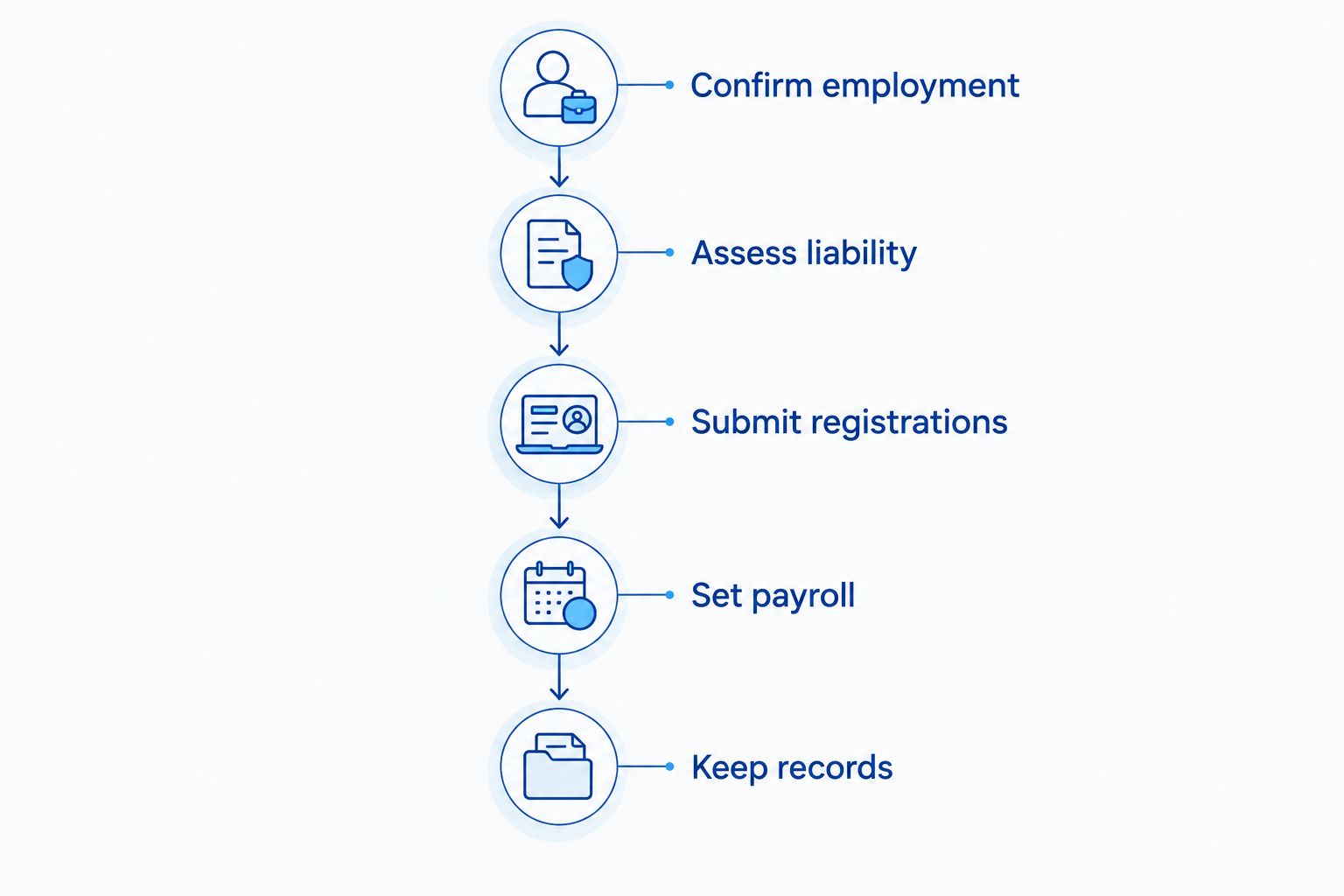
Use this sequence to brief your accountant, payroll administrator or registration consultant. Express Reg offers tax and labour registration services, while your service scope should identify who handles ongoing payroll and submissions.
Arrange your employer registrations
Discuss tax and labour registration support for your business.
Basis for the ranking
The assessment order follows each registration’s connection to employing staff. PAYE and UIF address employee remuneration and coverage; SDL depends on its levy rules; Compensation Fund registration addresses occupational injury obligations. VAT sits last because employment does not trigger it.
This order does not extend a statutory deadline. Assess obligations together if you have already hired, and prioritise any registration or submission that is due.
Choose the next action for your business
Before your next payroll, document the registration decision for each obligation and name the person responsible for it. For an existing team, check registrations against payroll records rather than starting duplicate applications.
Ask Express Reg for the scope of administrative support you need. Confirm whether that scope covers applications alone or includes further compliance work, and retain responsibility for supplying accurate business information.
FAQ
Do new employers in South Africa need PAYE, UIF and SDL registrations?
New employers must assess PAYE, UIF and SDL separately because each has its own rules. PAYE concerns employees’ tax, UIF concerns covered employees, and SDL depends on the levy requirements and exemptions.
Can an employee qualify for UIF without paying PAYE?
Yes, an employee can fall within UIF coverage without having a PAYE deduction. Assess UIF coverage and employees’ tax separately rather than using one result for both.
Is SDL deducted from an employee’s salary?
No, the employer pays SDL. The standard levy is 1% of leviable remuneration where the employer is liable, subject to the statutory rules and exemptions.
Does a small payroll qualify for an SDL exemption?
An employer generally qualifies for the payroll exemption if expected leviable remuneration over the next 12 months does not exceed R500,000. Check the statutory rules and review the assessment as payroll plans change.
Does hiring my first employee require VAT registration?
Hiring your first employee does not itself trigger VAT registration. Assess VAT against the rules for your business’s taxable supplies and turnover.
Is Compensation Fund registration part of PAYE registration?
No, Compensation Fund registration is separate from PAYE registration. COIDA addresses occupational injuries and diseases, while PAYE concerns employees’ tax administered by SARS.
Is Express Reg a government authority?
No, Express Reg is a privately owned business services consultancy and is not affiliated with a government authority. It provides company registration and compliance services, including tax and labour registration support.
One last thing
A payroll showing no PAYE deduction can still require UIF contributions and a Compensation Fund assessment. Before approving your first payroll in 2026, review each obligation on its own rules and keep the supporting decision with your employment records.