
Construction, cleaning, security, ICT, catering and transport are key industries that need CSD registration in South Africa when supplying government. For your 2026 application, treat CSD registration as a supplier-record requirement, then check the separate licences, qualifications and tender conditions that apply to your work.
- Industries that need CSD registration South Africa include construction, cleaning, security, ICT, catering and transport suppliers seeking government work.
- CSD registration records supplier information; it does not award contracts or replace sector licences.
- Construction contractors should check CIDB requirements; private security businesses should check PSiRA requirements.
- Express Reg suits entrepreneurs needing company registration and compliance support before pursuing government supply work.
Why CSD registration matters across industries
The National Treasury's Central Supplier Database, or CSD, holds supplier information used in public procurement. Government buyers use this information alongside the documents and declarations required for a particular quotation or tender.
Your industry determines the additional checks. A building contractor, a catering business and an IT consultancy can all need CSD registration, but their technical evidence will differ.
Express Reg is suited to entrepreneurs who need company registration and compliance support before seeking government contracts. Express Reg is a private business services consultancy, with no government affiliation. Registration support does not determine a government buyer's award decision.
For a 2026 procurement application, separate your business records, supplier registration and contract-specific evidence. Keeping these records organised helps you identify the document that needs attention before you submit.
Criteria for prioritising your industry's requirements
Use these criteria to decide which registrations and documents deserve attention before you pursue a contract:
- Scope of supply: Identify whether you will provide goods, professional services, physical works or a combination.
- Regulated activity: Check whether a regulator must authorise your business or the individuals doing the work.
- Tender eligibility: Read the conditions for the particular opportunity, including technical qualifications and compulsory documents.
- Record consistency: Match your legal name, registration details and banking information across supporting records.
- Delivery evidence: Prepare the experience, personnel, equipment or references that the buyer requests.
Apply these criteria to each 2026 opportunity. An industry label helps you prepare, but the published procurement documents set the requirements for that contract.
Government supplier industries at a glance
The order below groups industries by their distinct compliance considerations. It does not rank contract demand, profitability or your chances of winning an award.
| Industry | Best for | Main preparation priority | Key limitation |
|---|---|---|---|
| Construction and maintenance | Contractors bidding for physical works | Check the required CIDB class and grade | CSD registration does not establish contractor grading |
| Cleaning and facilities | Businesses providing site-based services | Define staffing, supervision and service scope | A supplier record does not prove delivery capacity |
| Private security | Regulated guarding and security services | Confirm applicable PSiRA registration | CSD registration does not authorise security operations |
| ICT and professional services | Technical and knowledge-based suppliers | Match qualifications and experience to the brief | General business registration does not prove technical competence |
| Catering and food supply | Food businesses serving public institutions | Check food-premises and handling requirements | CSD registration does not establish food-safety compliance |
| Transport and logistics | Operators providing transport or deliveries | Match licences, vehicles and permits to the work | Different transport activities have different requirements |
1. Construction: best for physical works contractors
Construction businesses need to distinguish supplier registration from contractor eligibility. Your CSD record identifies your business, while the procurement documents specify the construction credentials required for the project.
For public-sector construction work covered by CIDB requirements, check the applicable class of works and contractor grade. The guide to CIDB registration grades for South African contractors explains the grading considerations to review before selecting an opportunity.
Construction advantages:
- You can organise your supplier details separately from project-specific technical evidence.
- A clear scope lets you distinguish construction works from the supply of materials alone.
- Your existing project records can support experience requirements where the buyer requests them.
Construction limitations:
- CSD registration does not replace an applicable CIDB registration requirement.
- The wrong class or grade can leave your business ineligible for the advertised work.
Best for: Contractors pursuing building, civil engineering or maintenance work within their qualifications and capacity.
Read the scope before assuming that a maintenance contract follows the same requirements as your previous project. Electrical work, structural repairs and the delivery of building supplies involve different activities.
Verdict: Proceed with CSD registration, and check the required CIDB credentials before bidding.
2. Cleaning: best for site-based facilities services
Cleaning and facilities suppliers need to translate a broad service description into an operational plan. An office-cleaning contract can require different equipment, supervision and safety arrangements from a specialised cleaning assignment.
Your CSD registration supplies the buyer with business information. Your tender response must explain how you will deliver the specified service, using the evidence the buyer requests.
Cleaning advantages:
- You can define services around the sites and tasks your team can cover.
- A written staffing plan helps connect the contract scope to your operating capacity.
- Equipment and supervision records give you material for technical submissions.
Cleaning limitations:
- CSD registration does not demonstrate adequate staffing or equipment.
- Specialised tasks can carry requirements beyond routine office cleaning.
Best for: Cleaning businesses with a defined service area, documented working methods and suitable supervision.
Check the treatment of consumables, machinery, protective equipment and site access before preparing your response. A contract that includes supplies creates different delivery obligations from a labour-only service.
Verdict: Proceed after matching the service specification to your team, equipment and supervision.
3. Security: best for regulated guarding services
Private security suppliers must address sector regulation as well as procurement administration. CSD registration does not replace the Private Security Industry Regulatory Authority requirements that apply to security service providers.
Review your business's registration position and the requirements for personnel assigned to the contract. The guide to registrations South African security companies need provides a related starting point for organising these checks.
Security advantages:
- Separate supplier and regulatory records make compliance checks easier to organise.
- Personnel records help you answer contract-specific questions about deployment.
- A defined service scope helps you identify the authorisations relevant to your work.
Security limitations:
- A CSD supplier number does not authorise private security operations.
- Guarding, armed services and security-system work require attention to their respective rules.
Best for: Security businesses that can demonstrate the regulatory standing and personnel required for the advertised service.
Review the deployment schedule and equipment requirements before committing to the work. Your company registration documents alone cannot answer the buyer's questions about operational readiness.
Verdict: Hold your bid until applicable PSiRA and contract-specific requirements are in order.
4. ICT: best for technical and professional suppliers
ICT suppliers can pursue government opportunities involving equipment, support, implementation or specialist advice. Professional service businesses also need to match their qualifications and experience to the advertised brief.
Keep the distinction between supplying a product and delivering an ongoing service clear. The buyer can require different evidence for hardware delivery, software implementation, consulting and support.
ICT advantages:
- A defined technical specialism helps you select relevant opportunities.
- Project records can support experience claims where the tender requests them.
- Clear deliverables help you prepare a response against the stated scope.
ICT limitations:
- CSD registration does not prove technical competence or professional standing.
- The tender can require qualifications, manufacturer authorisation or professional registration relevant to the work.
Best for: Technical suppliers and professional practices whose skills match a specific government brief.
Read responsibility clauses for installation, maintenance, data handling and support. Supplying equipment does not establish your ability to accept all the service obligations attached to it.
Verdict: Proceed where your documented expertise matches the deliverables and eligibility conditions.
5. Catering: best for institutional food supply
Catering and food suppliers need to organise food-safety compliance alongside their supplier records. Public-sector opportunities can involve prepared meals, groceries or other food products, each with its own delivery requirements.
Check the Certificate of Acceptability requirements for the premises where you handle food. Confirm the position with the relevant local authority and read the buyer's specifications for preparation, storage and transport.
Catering advantages:
- A precise food-supply scope helps you identify relevant premises and handling requirements.
- Documented preparation and delivery procedures support your operational planning.
- Clear product specifications help you assess whether you can fulfil the order.
Catering limitations:
- CSD registration does not establish compliance with food-premises requirements.
- Storage, temperature control and delivery conditions depend on the food and contract.
Best for: Food businesses with suitable premises, handling procedures and delivery arrangements for the required supply.
Compare the requested delivery pattern with your preparation and transport arrangements. A supplier record cannot resolve a mismatch between the order and your capacity to handle it safely.
Verdict: Proceed after confirming the premises and handling requirements for the specified food supply.
6. Transport: best for delivery and fleet operators
Transport and logistics suppliers must identify the activity before checking the paperwork. Passenger transport, freight movement and courier delivery do not share one set of operating requirements.
Match the proposed service to the relevant driver, vehicle and operating requirements. Read the procurement documents for route coverage, insurance evidence and other conditions that the buyer specifies.
Transport advantages:
- A defined service area helps you identify contracts your operation can cover.
- Vehicle and driver records give you a basis for checking eligibility.
- Clear delivery responsibilities help you assess subcontracting arrangements.
Transport limitations:
- CSD registration does not replace applicable licences or permits.
- Requirements change with the transport activity, vehicle and route.
Best for: Operators with suitable vehicles, qualified drivers and the authorisations relevant to the advertised work.
Check who carries responsibility for loading, delivery confirmation and goods in transit. If you use subcontractors, review the buyer's conditions before relying on their capacity in your response.
Verdict: Proceed after confirming the operating requirements for the exact transport service.
Prepare your supplier records before applying
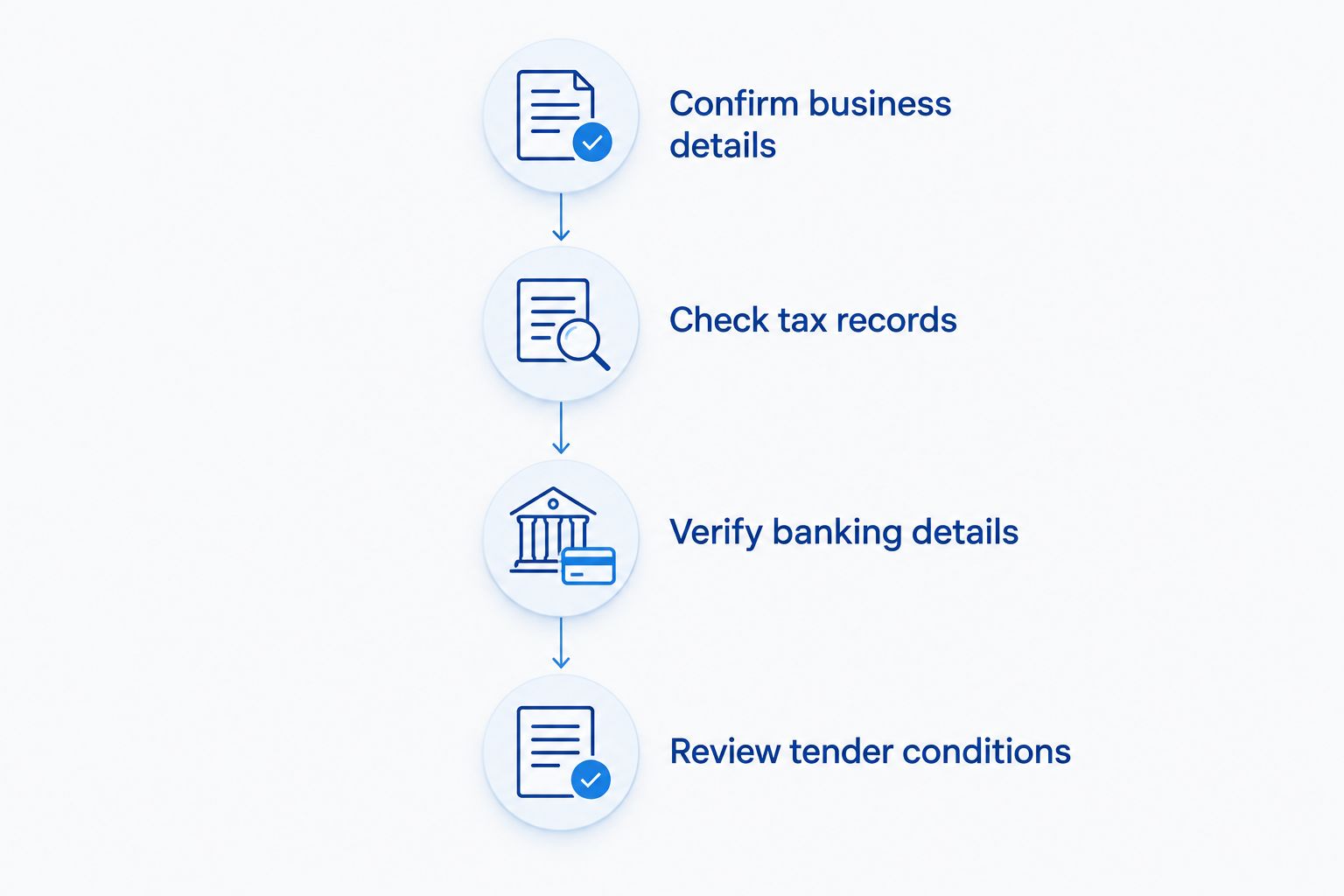
Use this sequence for your 2026 supplier preparation. Complete the business-record checks before treating a CSD record as ready for a tender submission.
Confirm business details
Check your legal name, registration information, ownership details and authorised representatives against your supporting records. Resolve inconsistencies before submitting information that relies on those records.
Check tax records
Review your SARS registration details and tax compliance position. Company registration, tax registration and tax compliance describe different administrative matters, so check each relevant record.
Verify banking details
Use banking information that matches the supplier entity and the evidence required for verification. Keep supporting documents accessible for follow-up checks.
Review tender conditions
Read the eligibility requirements, technical specifications and submission instructions. Confirm whether the opportunity requires sector registration, professional credentials, declarations or supporting certificates.
Keep responsibility for each record clear within your business. A consultant can help with administrative work, while you remain responsible for providing accurate information and checking the procurement conditions.
Basis for the industry selection
These six sectors illustrate different supplier-compliance needs, from contractor grading to food handling and transport authorisations. The comparison uses scope, regulated activity, tender eligibility, record consistency and delivery evidence, rather than an unsupported estimate of government spending.
Choose the next step for your business
Start with the advertised work, then build the registration checklist around it. Construction contractors should check grading; security providers should check regulatory standing; other suppliers should identify the licences and evidence relevant to their service.
Express Reg's company registration and compliance services suit businesses organising their underlying records. Keep that administrative support separate from the buyer's technical assessment and award process.
FAQ
Which industries need CSD registration in South Africa?
Businesses supplying government across construction, cleaning, security, ICT, catering and transport need to address CSD registration. These are examples rather than an exhaustive list; check the supplier requirements for your procurement opportunity.
Does CSD registration guarantee a government contract?
CSD registration does not guarantee a government contract. You must meet the opportunity's eligibility conditions and submit a response that the buyer evaluates under its procurement process.
Does a construction company need both CSD and CIDB registration?
A construction company needs to check CSD requirements alongside the applicable CIDB requirements for public-sector construction work. The advertised class of works and contractor grade determine the grading evidence to review.
Can a security company use CSD registration instead of PSiRA registration?
CSD registration does not replace applicable PSiRA registration. A private security provider must address sector regulation separately from its government supplier record.
Is CSD registration the same as tax compliance?
CSD registration and tax compliance are separate matters. Check your SARS records and tax compliance position alongside your supplier information.
Do catering businesses need documents beyond a CSD record?
Catering businesses must check food-premises and handling requirements as well as the buyer's conditions. Confirm the applicable Certificate of Acceptability requirements with the relevant local authority.
Can Express Reg award government contracts?
Express Reg is a private business services consultancy and has no government affiliation. Its company registration and compliance support does not determine a government procurement award.
One last thing
For your next 2026 submission, build a document checklist from the tender itself before reusing an earlier application. A current CSD record still leaves you responsible for the correct declarations, technical evidence and submission method for that opportunity.